Making a medical appointment in certain French municipalities can sometimes feel like an obstacle course. Several million people do not have a primary care physician, and the majority of the territory lacks healthcare professionals. In light of this situation, recent initiatives are attempting to reorganize access to care by combining local human presence with digital tools.
Telemedicine in rural areas: why a screen is not enough
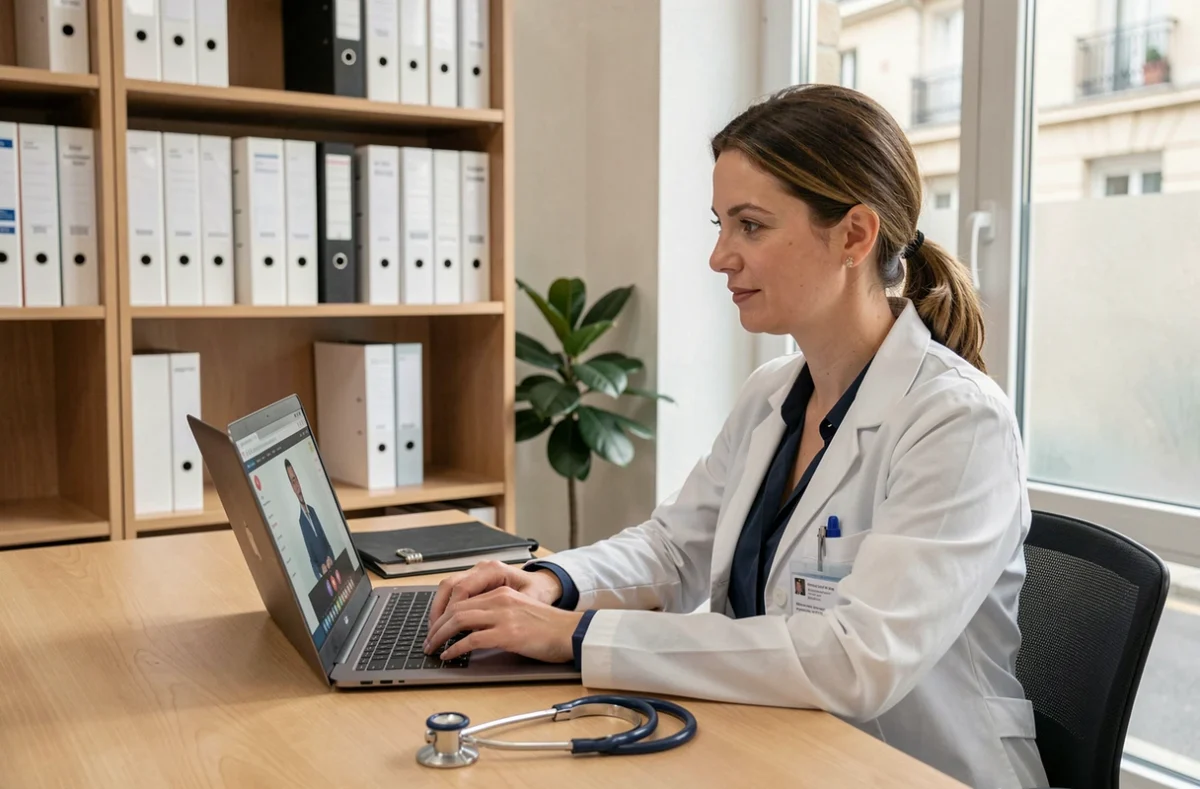
Have you ever seen a teleconsultation booth set up in a pharmacy or a town hall? The principle is simple: a patient enters, connects with a doctor remotely, and conducts their consultation via video. On paper, the solution seems to address the issue of medical deserts.
In practice, the system is more demanding. The call for expressions of interest launched in 2026 as part of France 2030 establishes a clear principle: each teleconsultation must involve a healthcare professional physically present with the patient. A nurse, pharmacist, or midwife accompanies the session, takes vital signs, and guides the examination. The absence of this professional is only permitted under exceptional circumstances.
This choice changes the very nature of telemedicine. It is not just a simple video call from one’s living room. The model relies on equipped care points, rooted in a territory, with trained personnel. It is a local infrastructure that utilizes digital technology, not an app that replaces human contact. Additional resources on digital health coordination can be found on hubsante.org, which aggregates tools intended for professionals in the sector.
Direct access to advanced practice nurses: what it changes for chronic patients
Since January 2025, certain patients can consult directly with an advanced practice nurse (IPA) without going through a doctor beforehand. This system applies to coordinated practice structures: health houses, health centers, and medico-social establishments.
Why does this evolution matter? Let’s take a concrete example. A diabetic patient being followed in a health house needs a treatment adjustment or a prescription renewal for their tests. Previously, they had to get an appointment with their primary care physician, sometimes facing several weeks of waiting. Now, the IPA can provide this follow-up directly, within their scope of practice.
The IPA is not a doctor. Their role is limited to the management of stabilized chronic conditions and prevention. Their additional training allows them to interpret results, prescribe certain tests, and renew treatments. This transfer of skills frees up medical time for consultations that truly require a doctor.
Conditions to benefit from direct access
- The patient must be cared for in a coordinated practice structure (multi-professional health house, health center, or medico-social establishment)
- The follow-up concerns a previously diagnosed chronic condition, not a new symptom or an emergency
- The IPA shares information with the patient’s primary care physician via the shared medical record, ensuring continuity of care
Regulation of teleconsultation platforms: the pricing framework as a lever for equity
Some teleconsultation platforms offer quick access to a doctor for an additional fee. The patient pays to reduce their waiting time. This model raises a direct question: does quick access to a caregiver become a two-tier service?
The regulatory framework tightened in 2026. Platforms must now comply with pricing compliance requirements that can directly affect their authorization to operate. In plain terms, a platform that charges fees not compliant with conventional rates risks losing its accreditation.
This regulation aims to uphold the founding principle of health insurance: the same price for the same service, regardless of the consultation channel. Reimbursed teleconsultation remains accessible at the conventional rate. Comfort supplements should not condition actual access to care.
France 2030 and medical deserts: the concrete criteria for the call for projects
The initiative, led by the Ministry of Territorial Planning and Decentralization in conjunction with the Ministry of Health, does not finance just any innovation. Selected projects must meet specific criteria:
- Propose a technological solution rooted in a territory identified as a priority intervention area, not a generic tool applicable everywhere
- Involve local healthcare professionals in the deployment, in line with the principle of human presence
- Demonstrate a measurable impact on the number of patients actually cared for, not just on the number of connections
- Fit into a viable economic model after the experimental phase, to avoid the “pilot without follow-up” effect
What distinguishes this call for projects
Digital health has seen many experiments in recent years, with uneven results. The uniqueness of this call for projects is that it conditions funding on a real territorial implementation. A project leader cannot apply with a mobile app alone. The solution must integrate into an existing care pathway, with identified local partners.
This requirement filters out purely technological projects disconnected from the field. It directs funding towards hybrid systems, where digital technology serves as a tool for professionals already present or in the process of being established.
Improving access to care in France does not rely on a single solution. Accompanied telemedicine, direct access to IPAs, and the pricing regulation of platforms form three complementary levers. Their common point: placing the healthcare professional at the center of the system, even when technology is involved.