
The timing belt synchronizes the moving parts of the engine: pistons, valves, camshafts. When it breaks, the engine suffers often irreparable damage. Its replacement is one of the most costly maintenance items on a thermal vehicle, and the budget varies significantly depending on the engine type, model, and chosen garage.
Wet belt and dry belt: two technologies, two levels of risk
The dry belt is mounted outside the engine block, while the wet belt is immersed in engine oil. This second technology, used notably on PSA-Stellantis 1.2 PureTech engines, has allowed for longer theoretical replacement intervals.
Field reports tell a different story. PSA-Stellantis has published several internal technical notes since 2020, adjusting the monitoring of the wet belt based on oil contamination rather than just mileage. Some vehicles equipped with the 1.2 PureTech have seen their recommendations extend to up to 10 years or 175,000 km, compared to 6 and a half years or 110,000 km previously. However, this extension assumes rigorous monitoring of oil quality.
In practice, an owner of a vehicle with a wet belt who neglects oil changes or uses non-compliant oil is at risk of premature degradation. Replacing a wet belt costs more than a conventional dry belt because the disassembly is more complex, and the kit includes specific components. Before asking how much a timing belt change costs, one must identify the type of belt fitted to their engine.
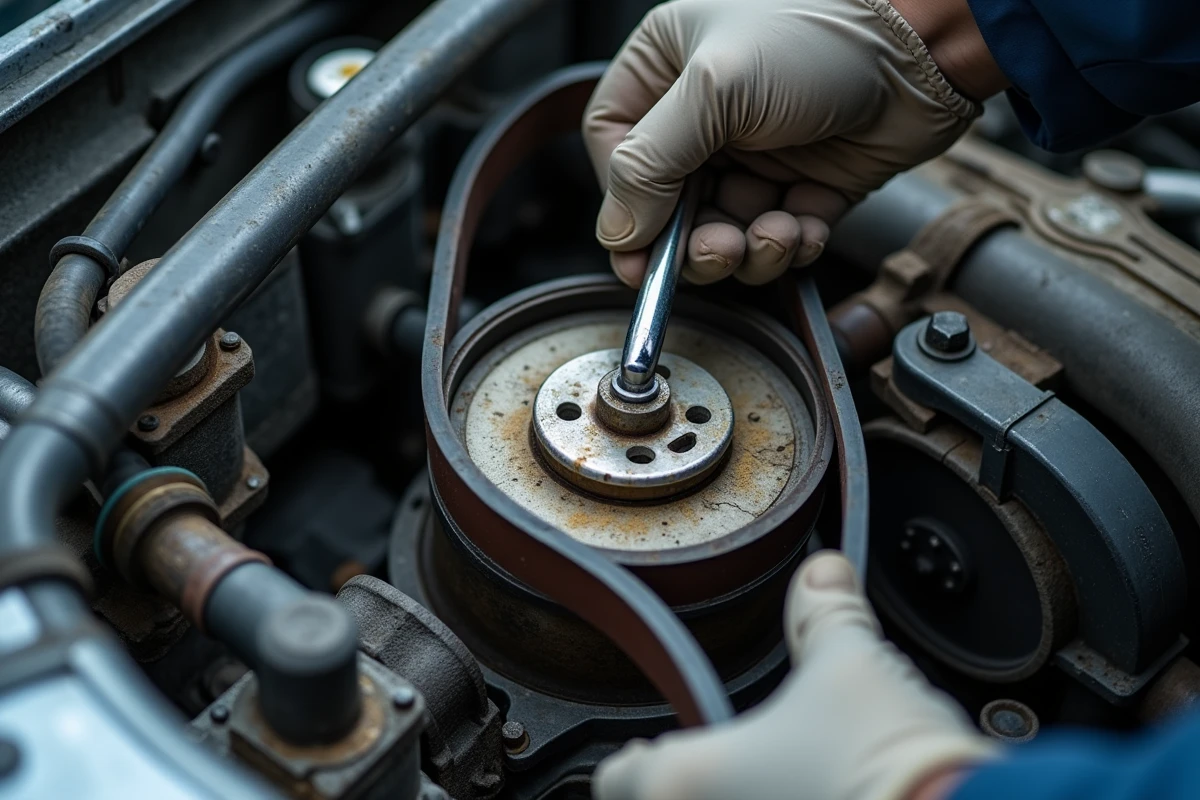
Cost of timing belt replacement: what affects the bill
The cost of a timing belt replacement depends on three main factors: the part itself, labor, and any elements replaced at the same time (complete or partial kit).
The timing kit and water pump
A garage almost never replaces the belt alone. The timing kit includes the belt, tensioner pulleys, and idler pulleys. Most professionals recommend changing the water pump during the same intervention, as it is driven by the belt and requires the same disassembly for access.
Replacing the water pump separately a few months later would mean paying for labor twice. Combining both operations represents significant savings in the long run.
Labor and engine accessibility
Labor often accounts for more than half of the total price. On some models, accessing the belt requires removing the engine mount or even tilting the block. A transverse engine in a small urban vehicle leaves little space, which extends the intervention time.
Differences between garages can also be explained by the hourly rate, which varies depending on the geographical area and type of establishment (dealer, auto center, independent garage). Requesting multiple quotes remains the most reliable way to avoid overpaying.
- The timing kit alone (belt, pulleys) costs significantly less than the kit with water pump, but the savings are misleading if the pump fails shortly after.
- Labor time varies from a few hours to a full day depending on the model, which directly impacts the bill.
- A detailed quote should distinguish the price of parts, billed time, and any fluids (coolant, oil on wet belt).
When to replace the belt: mileage, age, and warning signals
Manufacturer recommendations set an interval in kilometers and years. The age of the belt is as important as the mileage. A car that drives little but has a belt older than six or seven years poses a real risk: the rubber dries out, loses its elasticity, and can fail unexpectedly.
Several signals should alert before the theoretical deadline:
- A knocking or whistling noise at startup, indicating that the belt is slipping or that the tensioner pulley is weakening.
- Visible signs of cracking on the toothed side of the belt (when accessible for inspection).
- An abnormal oil consumption on wet belt engines, which may indicate premature contamination of the belt.
The insurance stakes of neglected maintenance
A late replacement not only costs the price of a broken engine. Uninsured claims for engine failures related to the timing belt have increased in recent years. Insurers may refuse coverage when maintenance, including the belt, has not been performed within the timelines set by the manufacturer.
The maintenance booklet stamped by a professional serves as the most direct proof of compliance with deadlines. Without this document, asserting a warranty or mechanical breakdown coverage becomes very difficult.

Comparing quotes: independent garage, auto center, or dealer
The reflex to go to the dealer for a timing belt change remains common, but the price is usually the highest there. Auto centers and independent garages often offer more competitive rates, provided they use quality equivalent parts (brands like Gates, Dayco, or SKF, suppliers for manufacturers).
A good quote mentions the exact reference of the kit, the brand of the water pump, and the expected labor time. If the garage refuses to detail these elements, it is a negative signal. Comparing three quotes allows for spotting abnormal discrepancies and negotiating with informed knowledge.
Changing the timing belt remains a significant but predictable operation. Replacing the belt before the manufacturer’s deadline and combining the water pump and timing belt in a single intervention helps limit the total cost. A quote detailing parts, labor time, and fluids provides the necessary visibility to compare offers.