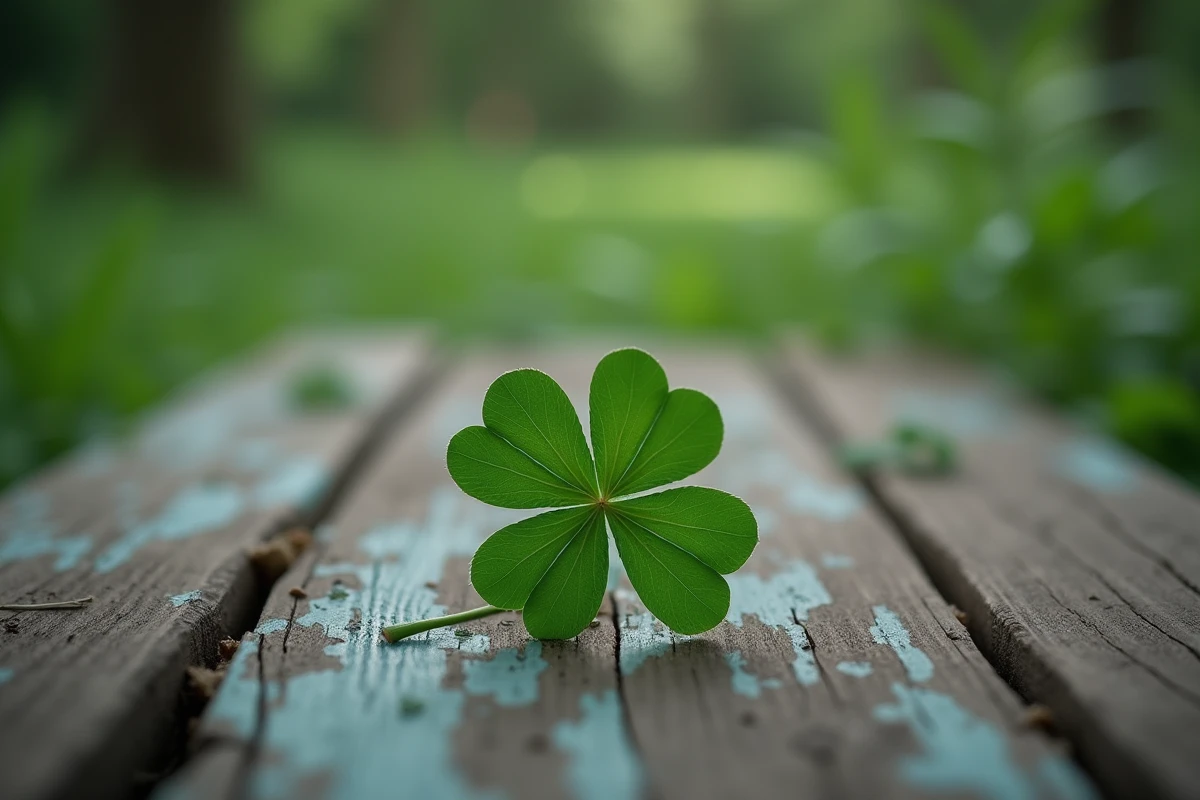
The five-leaf clover fascinates both botany enthusiasts and symbolism followers. With an estimated frequency of about 1 plant in 24,000, this genetic anomaly of the white clover (Trifolium repens) remains rarer than its four-leaf cousin. However, its actual rarity and spiritual significance deserve a more rigorous examination than what most esoteric specialty sites offer.
Rarity of the five-leaf clover: botanical data versus esoteric discourse
The statistic of 1 in 24,000 plants circulates widely on spirituality and lucky charm websites. It serves as the foundation for a simple commercial argument: the rarer it is, the more powerful it is. This logic ignores a crucial parameter.
Modern horticultural techniques allow for the selection and multiplication of clover plants exhibiting leaf mutations. By crossing genetically predisposed lines for supernumerary leaves, nurserymen produce clovers with four, five, and even six leaves in industrial quantities. The rarity invoked to justify a high price or superior symbolic power no longer corresponds to horticultural reality.
| Criterion | Wild five-leaf clover | Cultivated five-leaf clover |
|---|---|---|
| Frequency of occurrence | About 1 in 24,000 plants | Controlled production through genetic selection |
| Origin of the mutation | Spontaneous mutation (environmental factors, stress) | Selection of predisposed lines |
| Value on the esoteric market | High (scarcity effect) | Variable, often sold at the same price |
| Regulation in France (since January 2026) | Wild harvesting prohibited for commercial purposes without sustainable origin certification | Marketing allowed if traceability is ensured |
Decree No. 2025-1478 of December 20, 2025, published in the Official Journal, now prohibits the marketing of wild-harvested five-leaf clovers as amulets in France, except with sustainable origin certification. This measure aims to protect rare populations and directly impacts esoteric markets.
To delve deeper into the spiritual meaning of the five-leaf clover, one must distinguish between what belongs to symbolic tradition and what pertains to marketing.

Spiritual meaning of the five-leaf clover: what each leaf represents
In European popular tradition, the five-leaf clover carries a symbolism organized leaf by leaf. This breakdown, documented in occult treatises from the 19th century, assigns a specific domain to each leaflet.
- First leaf: faith, the foundation of personal or religious belief, identical to that of the three-leaf clover linked to the Trinity
- Second leaf: hope, related to the ability for positive projection into the future
- Third leaf: love, relational and emotional dimension
- Fourth leaf: luck, which already distinguishes the four-leaf clover from the common clover
- Fifth leaf: health or financial prosperity, depending on the sources, making it an amplifier compared to the four-leaf clover
This framework of interpretation remains stable in Francophone sources. In contrast, the symbolism varies radically across cultures.
The contrast with Japanese tradition
In Japan, a variant of the five-leaf clover (Oxalis tetraphylla variant) is traditionally associated not with individual luck, but with collective resilience after a disaster. This interpretation, documented in the Journal of Ethnobotany (vol. 42, March 2026), reveals a significant cultural gap.
Whereas the West projects a personal benefit (wealth, health) onto the five-leaf clover, East Asian tradition sees it as a symbol of community rebirth. This divergence questions the universality often claimed by spirituality sites that present their interpretation as absolute.
Climate mutations and five-leaf clovers: a documented link
A report from INRAE published on March 15, 2026, titled “Plant Mutations and Climate,” notes a rise in reports of five-leaf clovers in Europe since 2024. Temperate regions are particularly affected.
Climate change promotes environmental stresses on white clover: temperature variations, droughts followed by heavy rains, soil modifications. These stresses increase the likelihood of genetic mutations, including the one that produces a fifth leaf.
This phenomenon puts into perspective the notion of “sign of fate” often associated with the discovery of a five-leaf clover. If their frequency increases due to measurable climatic factors, the find loses some of its exceptional character.
Five-leaf clover and the esoteric market: what the French regulation changes
The December 2025 decree has had a tangible effect on the online trade of dried clovers, pendants, and amulets. Sellers who offered wild clovers as spiritual objects must now prove the sustainable origin of their specimens.
This regulation does not concern symbolic jewelry (earrings, bracelets, necklaces featuring a clover motif), but only actual plant specimens sold as amulets. The distinction is important for buyers seeking a symbol of luck or happiness.
- Cultivated clovers through genetic selection remain marketable with traceability
- Wild-harvested clovers require sustainable origin certification
- Jewelry and decorative items featuring clover motifs are not affected by the decree
The market is adapting: several nurseries now offer multiple-leaf clover plants, intended for individuals who wish to cultivate their own “lucky charm” in the garden.
The spiritual meaning of the five-leaf clover does not disappear with these regulatory and scientific developments. It shifts. The symbol retains its strength for those who attach personal intention to it, but the marketing discourse based on absolute rarity no longer withstands scrutiny from current botanical and climatic data.