
A blue can found in the garage, without a label. The smell doesn’t indicate anything specific, nor does the color. Coolant or windshield washer fluid, we hesitate, and it’s exactly in this ambiguity that filling errors occur. These two automotive liquids have neither the same chemical composition nor the same circuit under the hood, and confusing them can cost much more than just a simple tank cleaning.
Texture and smell: two reliable clues under the hood
Even before reading a label, one can distinguish these two liquids by touch. The coolant leaves a slightly greasy film between the fingers. This is due to its glycol base (ethylene glycol or propylene glycol), which also gives it a sweet taste, definitely not to be checked by mouth as the product is toxic.
The windshield washer fluid, on the other hand, feels dry to the touch and emits a clear alcoholic smell, sometimes mentholated depending on the brands. This difference can even be perceived on an unlabeled can: a drop between the thumb and index finger is enough.
To go further and understand how to differentiate coolant from windshield washer fluid, one can also compare their locations under the hood, as the two tanks are never found in the same place.
Coolant reservoir and windshield washer reservoir: identification under the hood
The confusion often arises from the fact that both tanks are made of translucent plastic and contain a colored liquid. On most vehicles, the wash fluid reservoir has a blue cap with a windshield pictogram. It is generally located on one side of the engine compartment, accessible without tools.
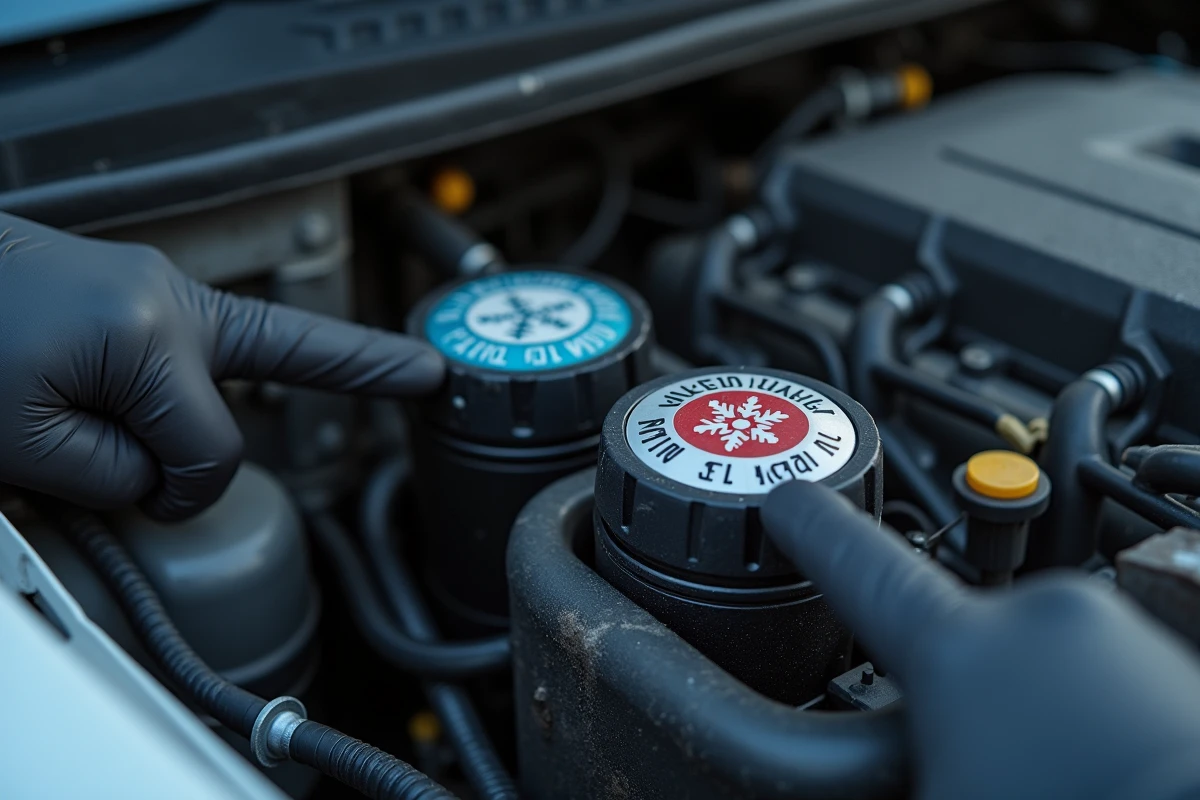
The coolant expansion tank, on the other hand, is connected to the engine by hoses. Its cap often bears a thermometer symbol or a warning mention (“do not open when hot”). It has “min” and “max” markers on the wall.
- Blue cap with wiper pictogram: windshield washer reservoir, non-pressurized circuit.
- Cap with thermal warning, connected to hoses: coolant expansion tank, pressurized circuit.
- In case of doubt about an unknown vehicle, the maintenance manual or the underside of the hood contains a diagram for locating the caps.
This check takes less than a minute and prevents an error with costly consequences.
Windshield washer fluid in the cooling circuit: what happens concretely
It is often said that one must “never interchange” the two liquids, without detailing the actual damage. Here’s what happens depending on the direction of the error.
Windshield washer fluid poured into the expansion tank
The windshield washer fluid mainly contains isopropyl alcohol. Introduced into the cooling circuit, this alcohol accelerates the corrosion of seals and internal components. At low temperatures, the mixture can also crystallize, which blocks the circulation of the liquid and causes rapid engine overheating.
If noticed quickly, a complete drain of the circuit followed by rinsing can limit the damage. But if the engine has run for a long time with this mixture, the head gasket and radiator are likely to be damaged.
Coolant poured into the windshield washer reservoir
The problem is different but real. The glycol base of the coolant clogs the nozzles and damages the washer pump. The product also leaves a greasy film on the windshield, which the wiper blades struggle to clear. In the long term, the blades degrade faster when in contact with glycol.
In this case, it is necessary to empty and rinse the windshield washer reservoir with clear water several times, then check that the nozzles are not clogged.
Coolant in electric vehicles: a distinct circuit not to be neglected
In a conventional thermal vehicle, the coolant regulates the engine temperature. In an electric or hybrid vehicle, a separate cooling circuit protects the high-voltage battery. This battery fluid is sometimes a different color (pink, orange) from that of the conventional engine circuit (green, blue).
This peculiarity adds an additional risk of confusion: one may end up with three colored liquid reservoirs under the hood instead of two. The vehicle’s maintenance manual remains the reference for identifying each circuit. Feedback varies on the compatibility between battery coolant brands, so it is better to stick to the manufacturer’s recommendation.
Level checks: when and how to verify
A quick check of the coolant and windshield washer fluid levels is part of the routine maintenance of the vehicle. It is ideally done with the engine cold, vehicle parked on flat ground.
- Coolant: the level should be between the “min” and “max” markers on the expansion tank. A regularly dropping level indicates a leak in the circuit.
- Windshield washer fluid: the reservoir does not have a precise gauge on all models, but the level can be seen through transparency. It is topped up with a product suitable for the season (antifreeze in winter).
- On an electric vehicle, the battery cooling circuit has its own indicator on the dashboard. An abnormal temperature warning justifies a quick stop.
Getting into the habit of checking these levels once a month, or before a long trip, is enough to spot an anomaly before it becomes a breakdown.
The distinction between these two liquids relies on simple clues (texture, smell, cap location) that any driver can learn to recognize. The safest reflex remains to never pour a liquid without having read the label, even if the color seems to match.